

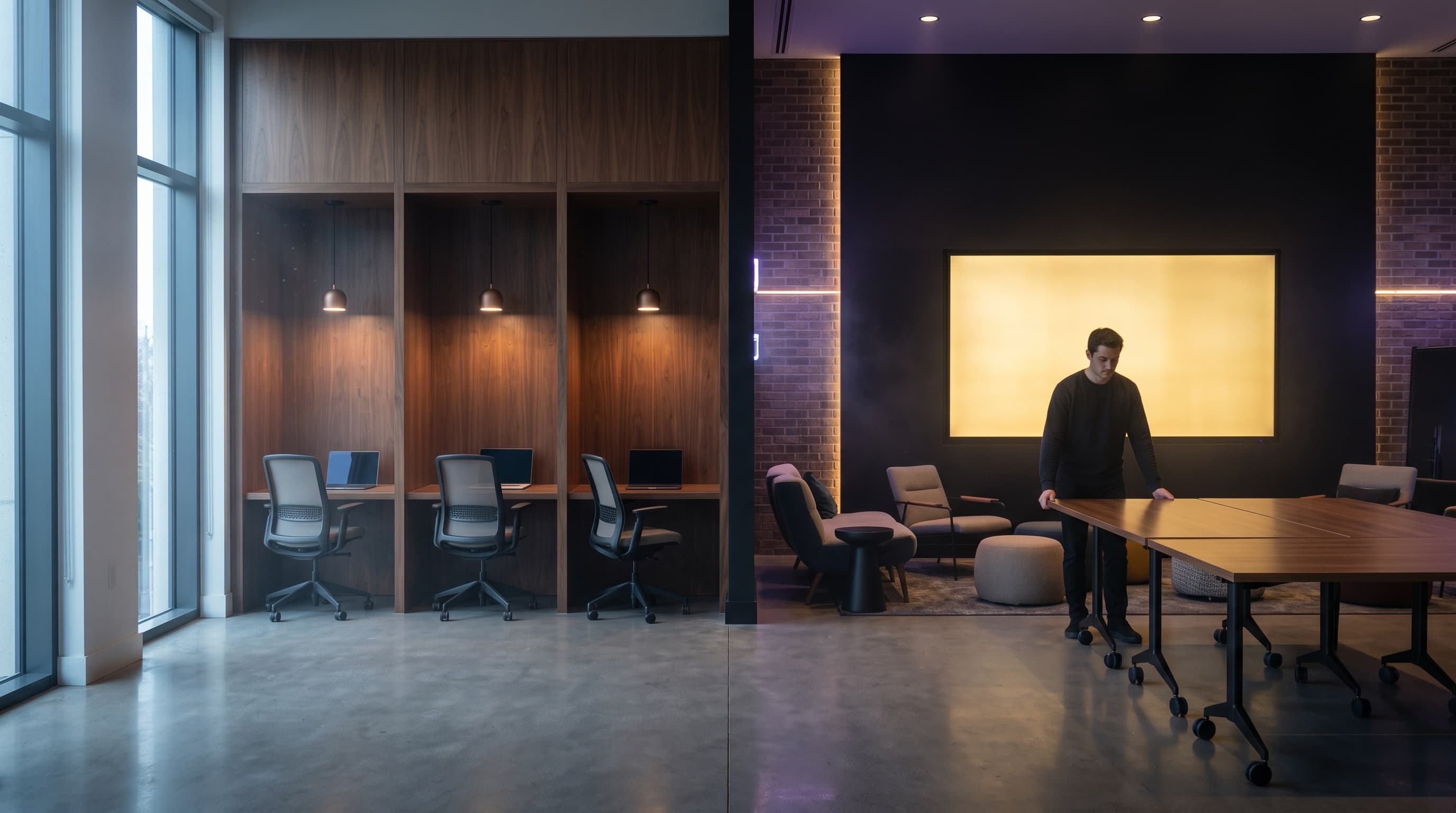
New development math has turned against big single-purpose amenity rooms. Construction costs and financing pressure are pushing developers to reduce total amenity square footage in favor of more rentable units, a trend Multi-Housing News flagged across its 2024 and 2025 outlooks. The projects handling this well are not cutting amenities. They are cutting single-use amenities, and making every remaining foot work multiple shifts.
The pressure is structural, not cyclical
Amenity space is expensive twice: once to build and forever to carry. Common areas including amenities, lobbies, and circulation typically absorb around 15% of a multifamily building's area, per Multifamily.loans' construction guidance, and none of that 15% pays rent directly. Frank Zhou, vice president at High Street Residential, put the risk plainly in Multifamily Dive's 2024 design trends report: overbuilding amenity spaces "results in increased costs and likewise increased rents."
Even at the luxury end, allocations are being watched closely. Building Design + Construction's 2025 luxury multifamily review cites The Laurent in Cambridge at 21,000 square feet of amenity space across 525 units, roughly 40 square feet per unit. When the flagship projects are running disciplined per-unit amenity budgets, mid-market developments cannot afford a 4,000 square foot room with one use case.
Flexibility is already the standard, not the trend
The design industry has largely settled this question. "Flexible spaces that accommodate a variety of functions, including remote work, have already become the new standard across multifamily," Mary Cook, president of interior design firm Mary Cook Associates, told Multifamily Dive in early 2024.
The demand data explains why. According to the NMHC/Grace Hill 2024 Renter Preferences Survey, 52% of renters work remotely at least occasionally, and 39% work from home several days a week. Renter interest in shared workspaces jumped from 35% to 48% between survey cycles, one of the largest moves of any amenity. That demand is real but it is also concentrated between 9 and 5 on weekdays. A room programmed only for daytime work is idle exactly when residents are home, and a room programmed only for evenings is idle exactly when remote workers need it. Flexibility is how one room captures both.
Design rules that make a space actually flexible
"Flexible" fails when it means an empty room with movable chairs. Nobody books a vague room. The pattern that works is a space with two or three defined modes and the infrastructure to switch between them fast:
- Work mode by day: real desks, task chairs, bookable call rooms, and enterprise-grade Wi-Fi. Booth seating (used at projects like BKV Group's Harwood Flats in Bethesda) outperforms open lounge furniture because it gives remote workers acoustic privacy without walls.
- Social mode by night: the same infrastructure that serves laptops serves gaming and events. High-bandwidth networking, dense power, large displays, and cluster seating convert a coworking floor into a game night, a watch party, or a tournament with no construction.
- Switching cost near zero: mode changes have to be a staff task measured in minutes, not a furniture project. Mobile storage, wall-mounted displays, and a fixed tech backbone with swappable furniture in front of it.
The tech backbone is the shared asset. Power, network, displays, and acoustics serve every mode, so overspending there is what makes underspending on square footage safe. This is the same shell-versus-program logic we laid out in how to future-proof apartment amenities, applied at the design stage where it is cheapest.
What to do with this
If a development is in design now, resist evaluating the amenity plan as a list of rooms. Evaluate it as a schedule: for each space, what is it doing at 10am on a Tuesday, 8pm on a Thursday, and 2pm on a Saturday? Any room with one answer is a candidate to merge. The goal for a new project is a smaller amenity footprint where every space has a daytime job and an evening job, shared infrastructure good enough for both, and a program calendar that proves it to prospects on tour day.