

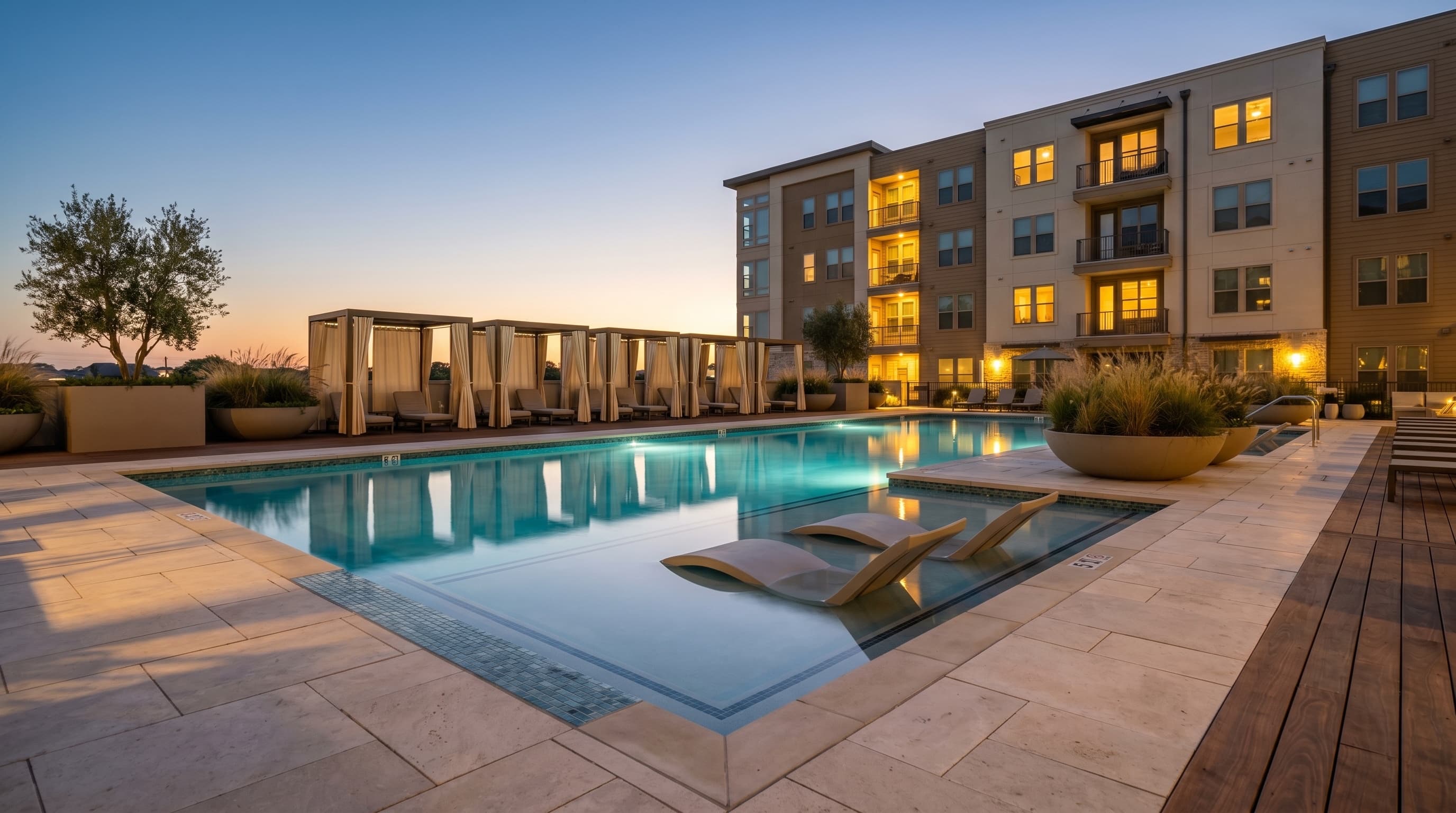
Most underwriting models treat the pool as a single CAM line. The real number is wider, and once heating is loaded in, it stops looking like a maintenance item at all. A routine service contract sits in one range, but the all-in annual operating cost of a heated commercial pool sits an order of magnitude above that, and energy is the line that compounds.
The maintenance number is wider than it looks
Start with the baseline. According to Pool Troopers and HomeGuide benchmarking, routine maintenance on a typical apartment or HOA pool runs $10,000 to $20,000 per year. Monthly service contracts span an even wider band: PoolFounder puts commercial pool service in the $250 to $2,000+ per month range depending on size, complexity, and the scope of work.
That range alone is large enough to be material when running comp underwriting across a portfolio. A $250 per month contract and a $2,000 per month contract represent the same line item in a CAM schedule, but roughly an 8x difference in real cash out the door. Two properties with what looks like the same amenity on the rent roll can have very different operating profiles.
The full annual on a real California pool
Routine service is only one slice. Industry consultant Gal Moyal, writing on LinkedIn, has documented the full annual operating cost on a large commercial and resort pool in California at approximately $107,609. The breakdown:
| Line item | Annual cost |
|---|---|
| Gas heating | $41,209 |
| Electricity | $16,400 |
| Water and backwash | $22,500 |
| Chemicals | $5,000 |
| Equipment and other | balance |
| Total | ~$107,609 |
That figure does not include capex, liability premiums, or the staff cost of lifeguard coverage where it is required. It is the cost of running the pool alone, and roughly 54% of it is energy.
Energy is the line item that scales
The energy share is not California-specific. The Center for Sustainable Energy reports that a heated commercial pool consumes natural gas at a rate equivalent to roughly 150 single-family homes, producing utility bills that, in its words, run "up to tens of thousands of dollars" per year.
The residential math from the U.S. Department of Energy frames the per-square-foot scale. A 1,000 sq ft outdoor pool in New York costs $1,448 to $2,384 per year to heat with natural gas, or $740 to $1,220 per year with a heat pump. Multifamily pools are typically several times that footprint, run on longer seasons or year-round, and serve dozens of households rather than one.
That is why energy is the line that scales when underwriting a pool. Routine service tracks roughly with property size and contract scope. Heating tracks with surface area, season length, climate, and fuel cost, and all four of those drivers have been moving in the wrong direction.
What this means for the amenity stack
For owners modeling new amenity installs or renovating an existing stack, the practical takeaway is to underwrite the pool on the heated-commercial number, not the routine maintenance number. The $10,000 to $20,000 line is the floor. The six-figure case is the ceiling for a heated, year-round, well-trafficked pool in a high-fuel-cost market.
That changes the math when comparing amenities. A space-equivalent indoor amenity, whether it is a gaming lounge, a golf simulator, a racing simulator, or a coworking room, carries no fuel load, no chemical line, no backwash water, and no seasonal closure. Operating cost on those amenities is dominated by electricity, occasional service, and software licensing. Those categories scale roughly with usage rather than with surface area and climate.
That does not mean ripping out existing pools. The cost of decommissioning is real, and pools are sticky residentially. But on new construction, renovation cycles, and underwriting comps, the relevant comparison is not "pool versus no pool." It is "pool at its real operating number versus an indoor amenity at its real operating number." Most stacks have been comparing the wrong two figures.
What to do with this
Before approving the next pool refresh or signing the next service contract, pull the trailing twelve months of utility billing for the pool's gas meter and electric submeter, and compare them against the maintenance contract on the same line. If the energy total is the larger number, the amenity is being managed by a service vendor when it is being driven by fuel cost. That is the line worth modeling forward, not the one that sits on the monthly invoice.