

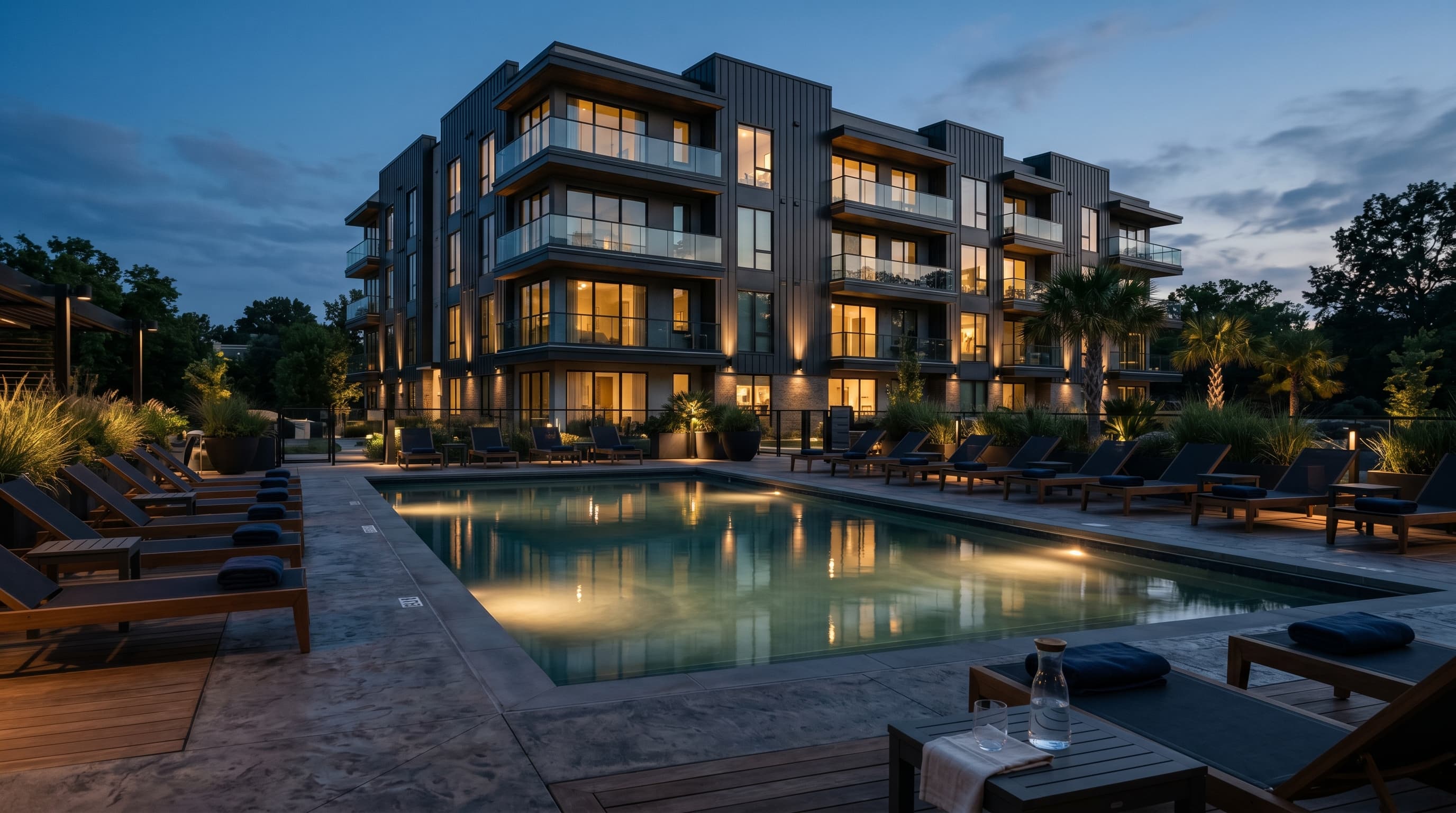
The line item nobody planned for in the 2018 amenity arms race has caught up. Multifamily insurance per unit is up between 55% and 119% over the last five years, depending on which dataset you trust, and the items driving the climb are the exact features properties installed to win the lease. Pools, gyms, saunas, hot tubs. The math that justified those amenities five years ago no longer pencils once 2024-vintage insurance numbers are loaded into the model.
How fast it moved
The repricing is recent and steep. According to National Apartment Association benchmarking, average multifamily insurance per unit rose from $502 in 2021 to $777 in 2024, a 55% increase in three years, with same-store data showing a 25% inflection in 2023 alone.
Federal Reserve research puts the climb steeper still. Real per-unit insurance costs rose roughly 75% to 77% between 2019 and 2024, going from about $39 per unit per month to $68. RealPage data on the same window shows a 119% increase between pre-pandemic levels and November 2023, with $30 per unit climbing to $65.
A Federal Reserve Bank of Minneapolis survey of 35 owners covering roughly 45,000 units captured the shape of the curve: premiums increased 14% in 2022, 22% in 2023, and 45% in 2024 year over year. That last number is roughly six times the rate of CPI inflation.
Why amenities specifically
Insurance carriers know which features generate claims. Pools are formally classified as an "attractive nuisance" under U.S. insurance law, and the Insurance Information Institute recommends pool-owning properties carry between $300,000 and $500,000 in liability coverage at minimum, with umbrella policies frequently required on top. Diving boards and slides can render a property uninsurable with some carriers entirely.
NMHC's 2024 State of Multifamily Risk Survey found that while property insurance saw its first decline since 2017, liability lines continued to climb, driven by litigation costs, so-called "nuclear" jury verdicts, and restrictive underwriting. Those are the precise coverage lines most exposed to gym injury, pool drowning, and sauna burn claims.
The Minneapolis Fed data backs this up at the property level: pool- and amenity-heavy buildings saw the steepest premium hikes in the survey. Every amenity layer compounds the liability tail rather than diversifying it.
The ROI math is breaking
Five years ago, the amenity calculus was straightforward. Install premium features, charge a 5% to 20% rent premium, recoup the capex over the hold period. That model assumed insurance was a stable line item. It is no longer.
Run the math on a 200-unit property:
| Year | Insurance per unit / month | Annual cost (200 units) | Delta from 2019 |
|---|---|---|---|
| 2019 | $39 | $93,600 | baseline |
| 2024 | $68 | $163,200 | +$69,600 |
The roughly $70,000 per year in additional insurance, on a property of that size, can absorb the entire rent premium that a $400,000 amenity install was supposed to generate. The amenity is still there. The differentiation is still real. But the operating cost has eaten the return.
What the smarter capex stack looks like
Owners are recognizing the pattern. The amenities being built into 2025 and 2026 deliveries skew toward features that differentiate without compounding the liability tail: co-working lounges, package management, smart locks and access control, gaming lounges. None of those carry the per-incident exposure of a pool or a sauna.
That doesn't mean ripping pools out of existing properties. The cost of decommissioning often outweighs the carry. But for new construction and renovation cycles, the question shifts from "what amenity wins the brochure" to "what amenity wins the brochure without doubling the insurance line item."
What to do with this
For owners and operators, the practical step is straightforward. When underwriting any new amenity install, treat the insurance impact as a load-bearing line in the model, not a footnote. Pull the most recent quote from the carrier before signing the construction contract, not after. The amenity that pencils on capex alone may not pencil once the next renewal hits.